Vazaro
A home-goods e-commerce platform with marketplaces and logistics.
Vazaro
How a premium retailer's e-commerce platform grew for almost 20 years without a full rebuild
What usually happens to an online store when it lives long enough? First it helps the business grow. Then it accumulates integrations, content, logistics, analytics, and compromises. A few years later, the familiar temptation appears: would it be easier to tear everything down and start again?
This is a story about how a well-planned architecture allows an online store to grow together with the business instead of starting over every few years. Rather than going through a series of relaunches, the platform has evolved with the business for almost 20 years while staying current and resilient.
This case study includes project images: interface screens, visual materials, and examples of implemented solutions.
Context
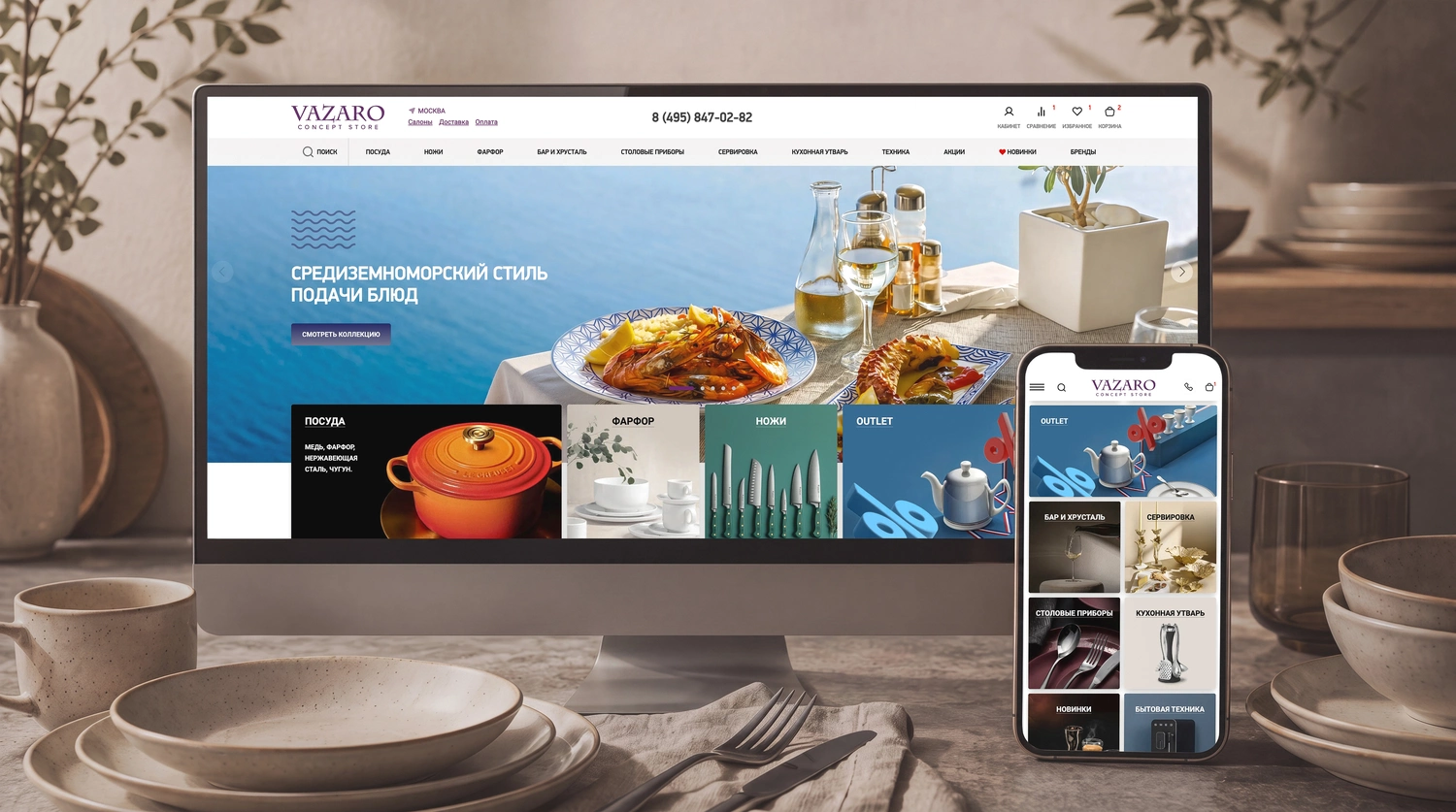
Vazaro works in the premium tableware, kitchenware, and interior goods segment. It is a specialized multibrand project: an online store, showrooms in Moscow and Saint Petersburg, delivery across Russia, and a broad catalogue of leading European brands. At the start, it was a niche test with about 20 brands and 5 000 products. Today the platform supports about 200 brands and a daily updated catalogue of 58 000 SKUs.
For this assortment, choice alone is not enough. Customers need to navigate it easily. They come not just for a "product", but for a style, a matching set, a brand, or a complete collection. As the project grew, the key task became not only expanding the catalogue but also building a clear path to purchase.
Our Role
Since 2008, we have been responsible for developing the online sales platform in line with the client's business strategy, offering tactical solutions with practical impact. The main challenge was to keep the project relevant across different market periods through gradual evolution, without rewriting the whole architecture and while preserving return on investment.
Our areas of responsibility:
- product strategy and UX;
- design and development;
- database information architecture;
- technical SEO;
- analytics and commercial hypotheses;
- integrations with ERP, payments, delivery, marketplaces, and advertising systems;
- security, server support, and backups;
- content support and journal development.
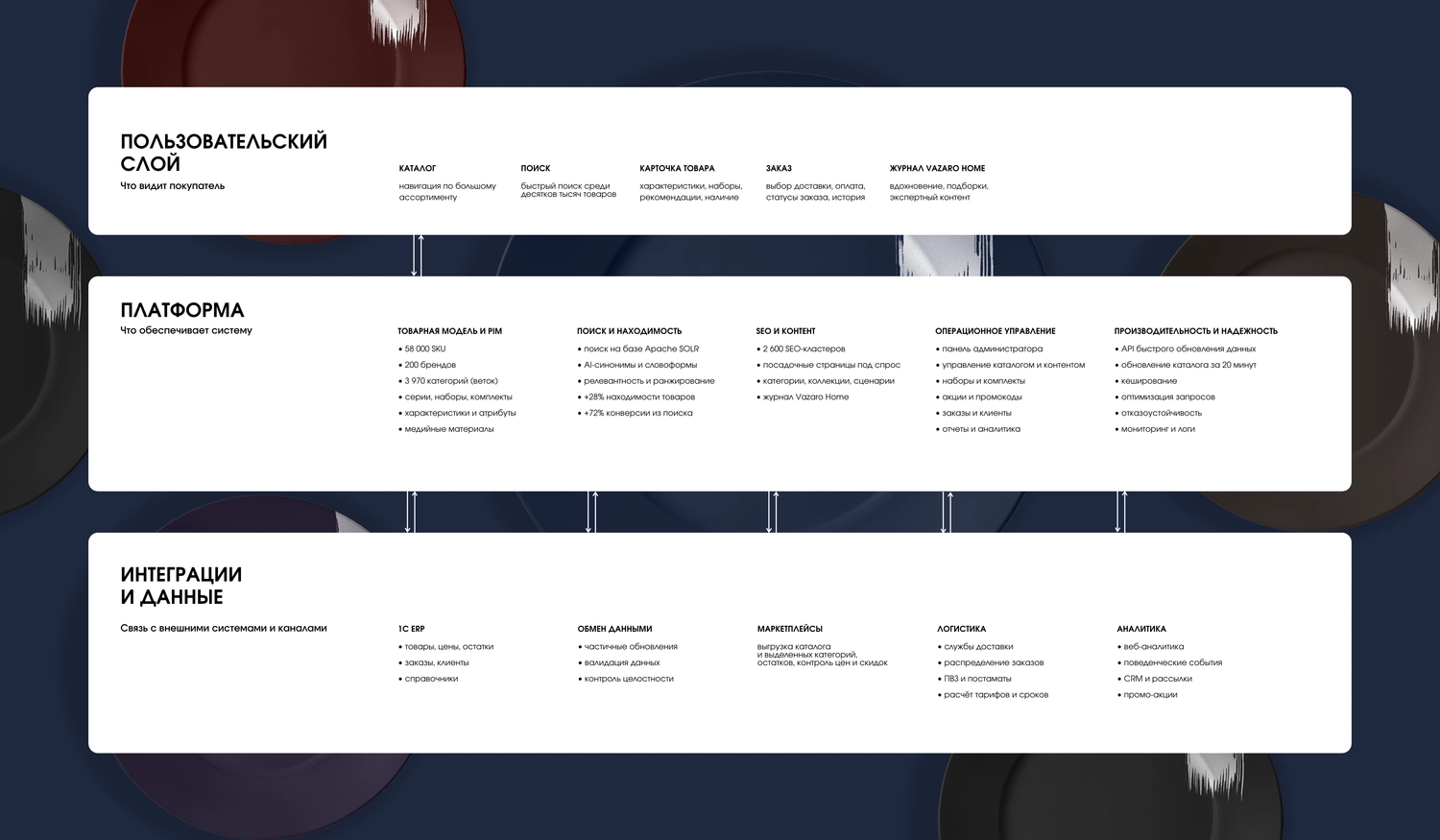
Diagram of the Vazaro e-commerce platform: user layer, product model, search, SEO, operations, integrations, marketplaces, logistics, analytics, and business value.
Architectural Foundation
The key foundation of the project was laid at one of the early stages of its development, in 2012, when the architecture Vazaro still runs on today took shape.
Instead of a classic CMS, we used what after the 2020 boom is now commonly called a PIM approach: the client's ERP system became the source of truth for the catalogue. We were not building a website with an internal catalogue. We were building a platform that receives product data from outside: structure, product information, prices, and stock levels, then updates quickly without stopping sales during data exchange.
Continuity and update speed are supported by:
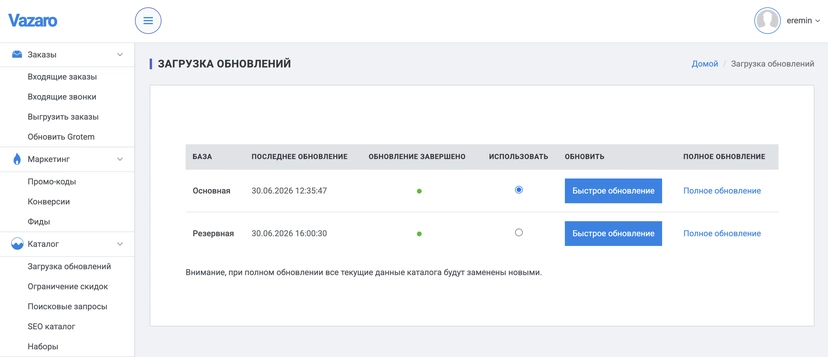
- separating the catalogue into primary and reserve databases so the website continues to work during updates;
- full and partial product-data updates during exchange;
- a separate image-update pipeline and two-level caching;
- an API layer for working with orders.
Even with the initial 5,000-SKU catalogue, it was clear that the project needed fast database synchronization and uninterrupted website operation during updates. In live e-commerce, catalogue updates are not a back-office routine. If the data updates slowly, the website starts lagging behind the business, and so does the user experience.
The viability of this architecture was especially clear during the 2024 migration to 1C: the website did not require a major rebuild.
The Principle of Managed Complexity
Vazaro did not develop through abrupt technology leaps. It grew through consistent improvements. We tried not to add complexity unless it was necessary: every solution was evaluated in terms of payback, maintenance, and impact on business processes.
Before introducing a new feature, we asked several questions:
- what business problem does it solve;
- will the implementation and maintenance costs pay off;
- will it complicate the user journey or the team's work;
- can the problem be solved more simply;
- will the solution keep the platform flexible in the future.
This pragmatic approach helped the platform go through different market periods: growth, crises, changes in sales channels, an ERP change, and increasing e-commerce infrastructure complexity.
A Business Platform
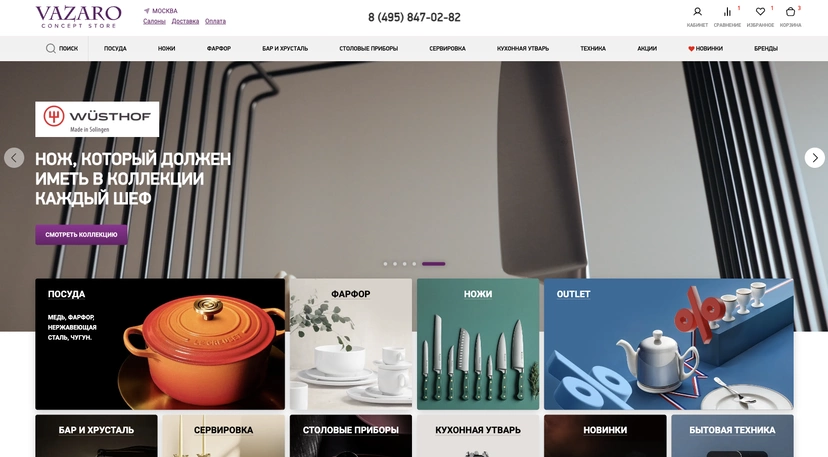
Vazaro is not only a customer-facing storefront. It is a working system for catalogue management, orders, content, and operations.
The platform solves several layers of tasks:
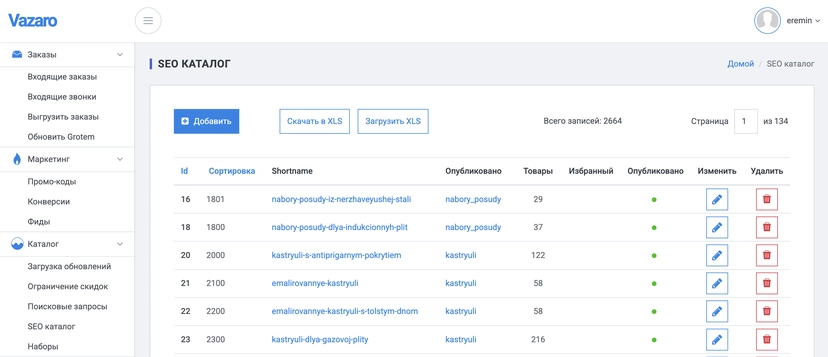
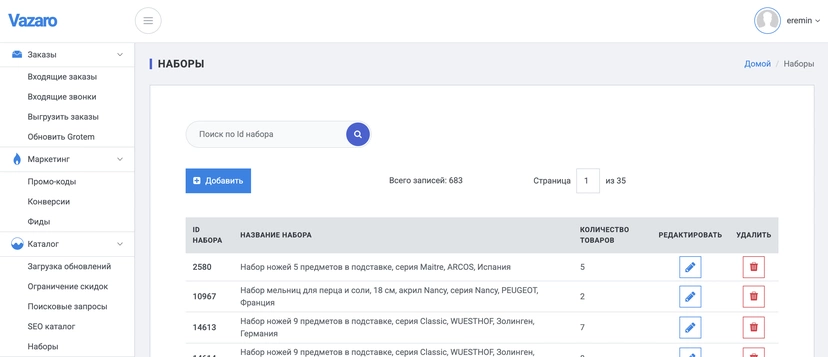
- managing a complex multibrand catalogue;
- managing product clusters;
- synchronizing data, orders, and media content;
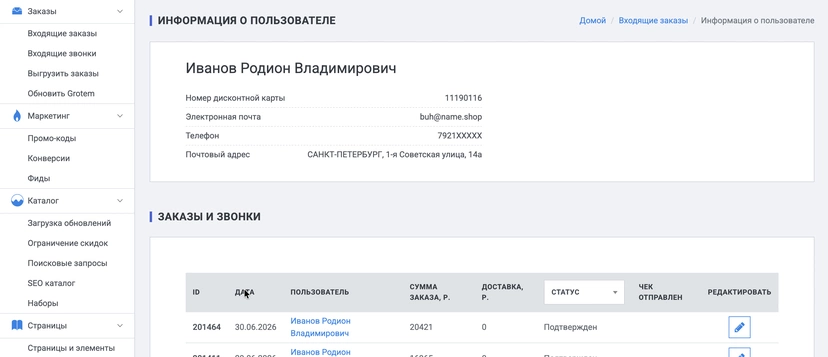
- service workflows for managers and customer support;
- working with marketplaces and advertising systems;
- loyalty and pricing policies;
- a content layer connected to products and categories.
Fact: the catalogue is updated several times a day, and the working update cycle takes no more than 20 minutes. By comparison, in typical heavy implementations on popular CMS platforms, similar operations can take several hours.
User Experience
The online store is part of the customer's overall journey, whether it begins with an online ad, search, or a marketplace. In every case, it is a continuous path that accounts for mobile-first behavior, spontaneous purchases, planned or delayed purchases, and situations where products appear or disappear from stock.
One early observation was that the website converted worse among the audience that mattered most to the project. This shaped the first major UX update: we started not with the homepage, but with key catalogue landing pages, the entry points where commercial demand was already being formed.
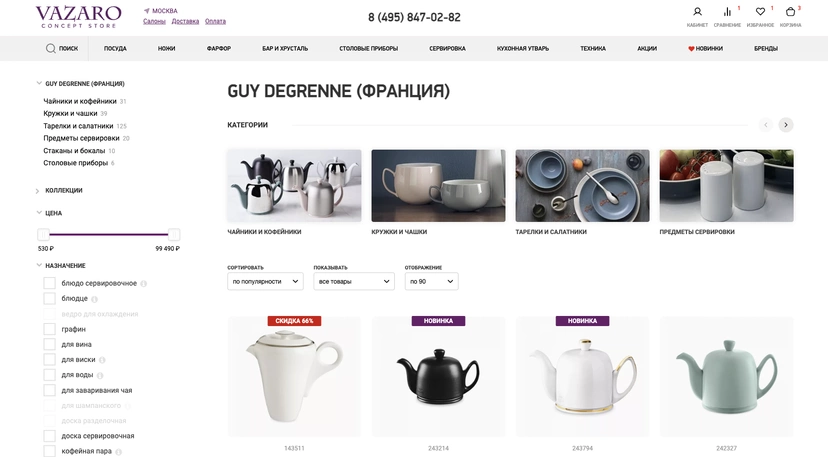
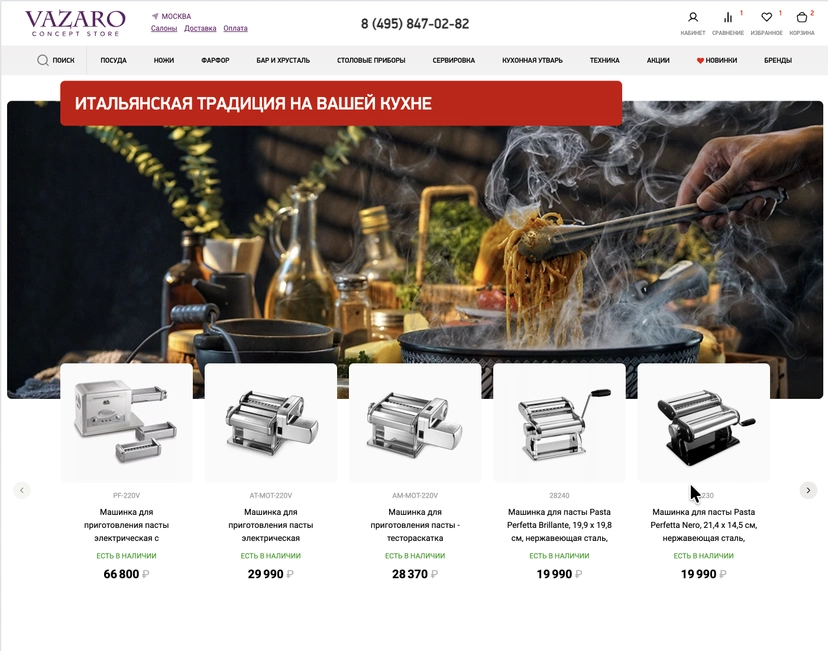
The visible tip of the iceberg on the homepage looks like a familiar online store. That is intentional. The interface uses patterns users already know instead of asking them to solve puzzles. The main task is for the customer to find a product in one of several ways and move easily toward purchase.
Purchase Scenarios: Find, Compare, Choose
For a premium assortment of 58 000 SKUs, selection scenarios matter: by style, brand, purpose, completeness, and product compatibility. The question is not how many products are on the site. The question is whether customers can navigate them and buy.
That is why we use these mechanics:
- category clusters that highlight popular selections;
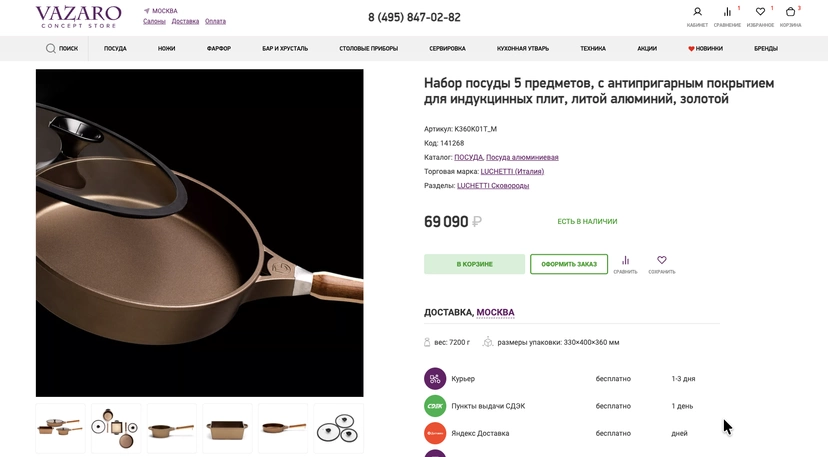
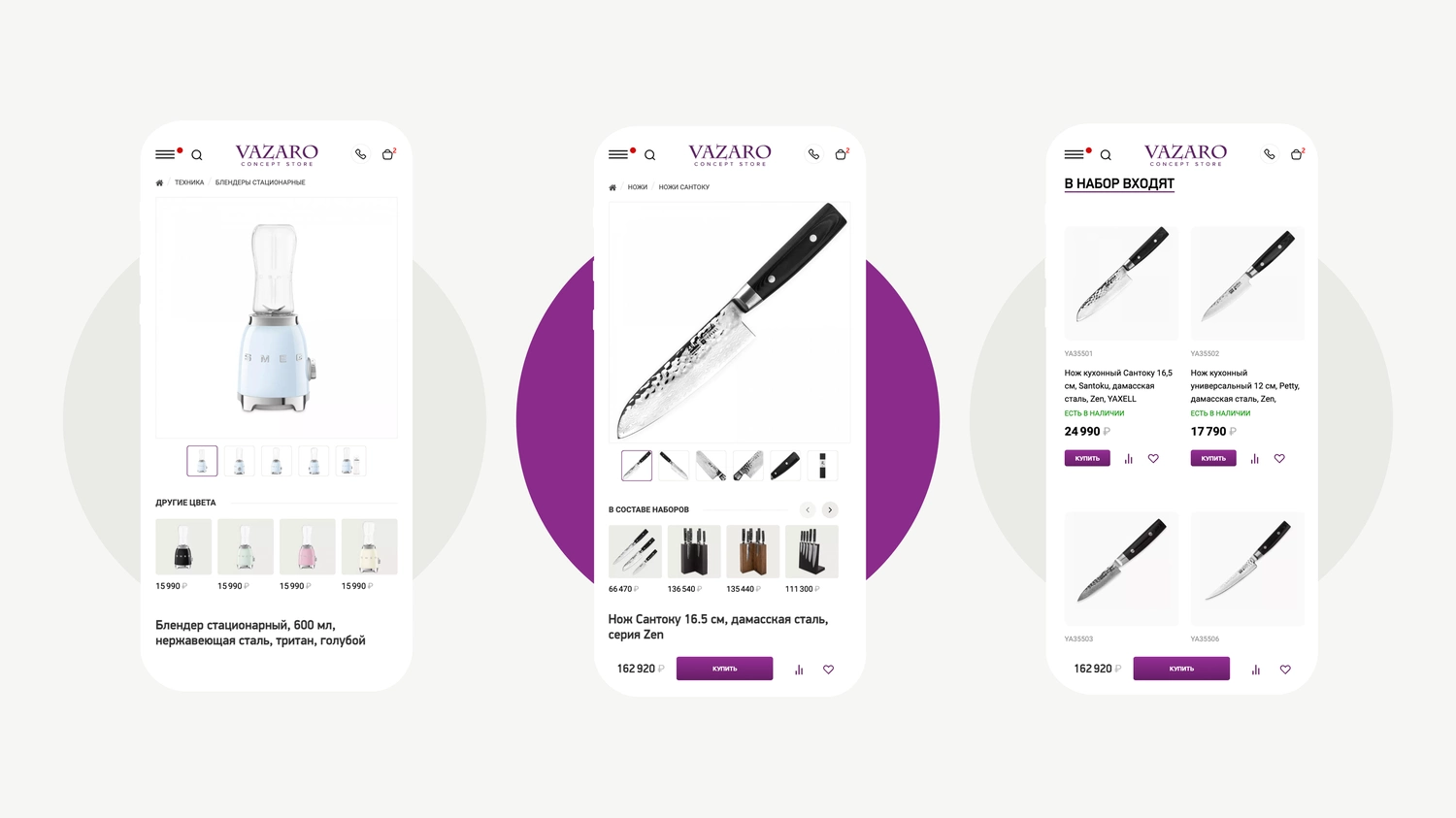
- similar products: for example, for a 0.5-litre Bugatti kettle, we show alternative colours and volumes;
- if a product is a set, we provide paths to individual items and series; if a product is part of a set, we show which sets include it;
- product recommendations work through an internal algorithm based on catalogue visit history and RetailRocket widgets integrated with email campaigns.
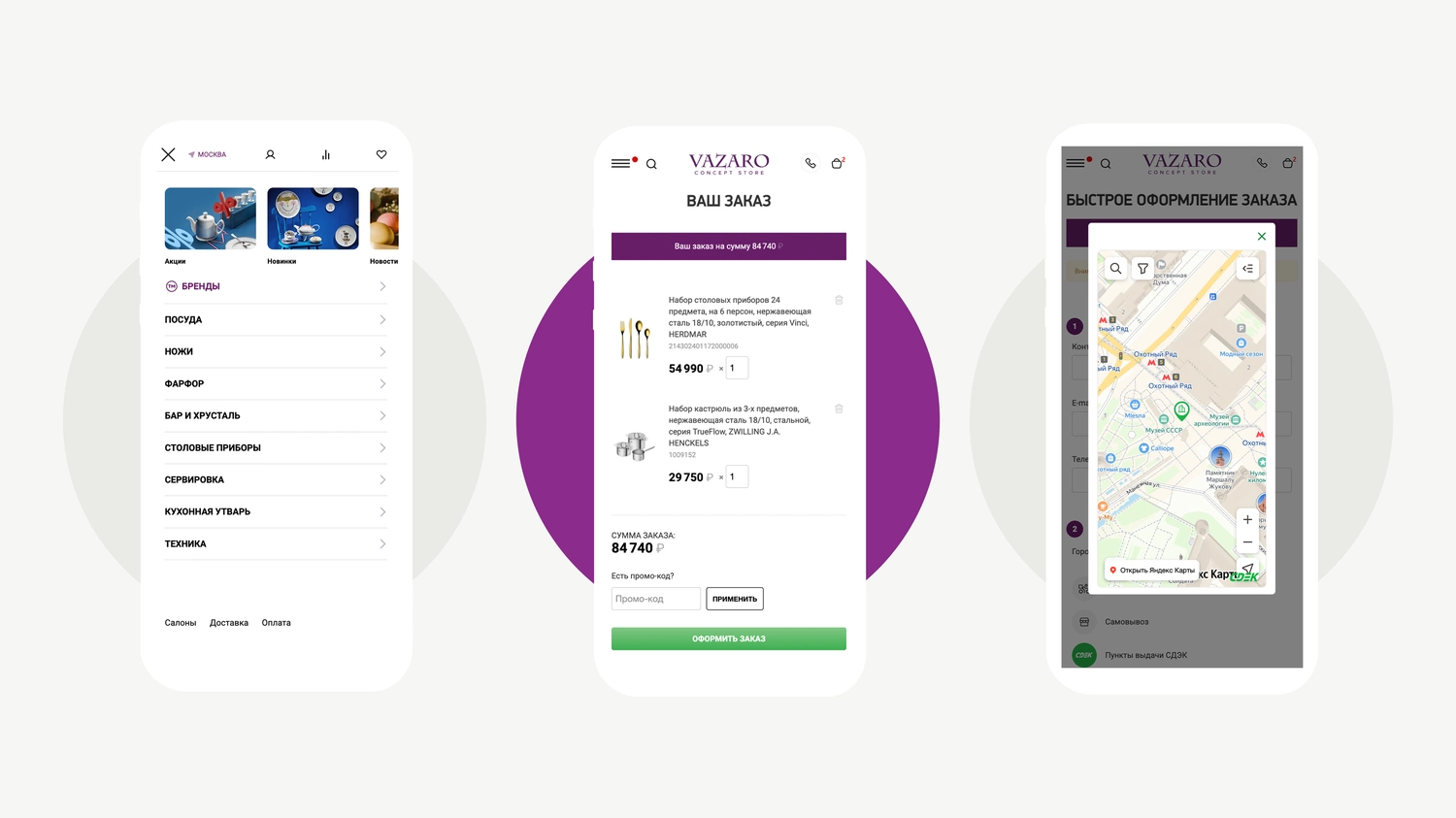
Shopping Cart
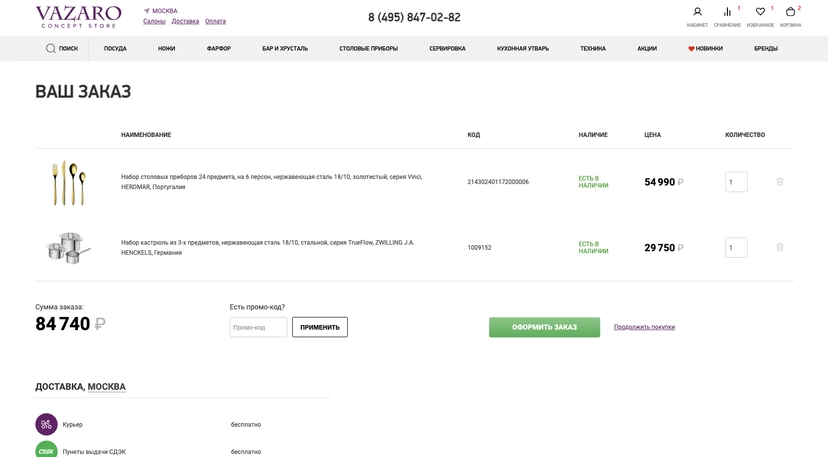
The cart accounts for active discounts and the policies that determine how they are applied. We distinguish between:
- current promotional discounts;
- regular-customer discount level;
- promo codes.
Order
Checkout is a critical phase of the user journey, where all likely user reactions and input errors need to be handled. We use three core scenarios:
- an order from a new customer;
- an order from a customer signed in to their account;
- an order from a returning customer who is not signed in;
- an order created by a manager during a phone call.
We automatically link orders and calls to an existing customer profile, or create a new one if the customer is new. The customer receives notifications throughout the order lifecycle by SMS and email, if an email address was provided.
Customers can choose and save addresses for future orders, both for themselves and when ordering for someone else, for example as a gift. Depending on the customer's city, the platform offers available payment and delivery options, including order-total restrictions by geography.
AI Search
When we were improving search, it was tempting to move toward "smart" AI solutions: semantics, embeddings, and ready-made engines that try to understand what the user meant. For Vazaro, this was not the right scenario. If a person searches for a "frying pan with a lid", they expect to see exactly that, not a loosely related alternative.
So we developed search not as "magic AI" but as a controlled system for a specific assortment. It is based on SOLR and an AI layer powered by GigaChat: first, precise query understanding; then careful expansion through word forms and synonyms; and only after that, ranking. This gave the project what matters most in live e-commerce: stable speed, controlled relevance, and trust in results.
Fact: after the AI search launch, product findability grew by 28%. For a project with an average order value above 20,000 roubles, this became a tangible commercial effect.
Inspiration
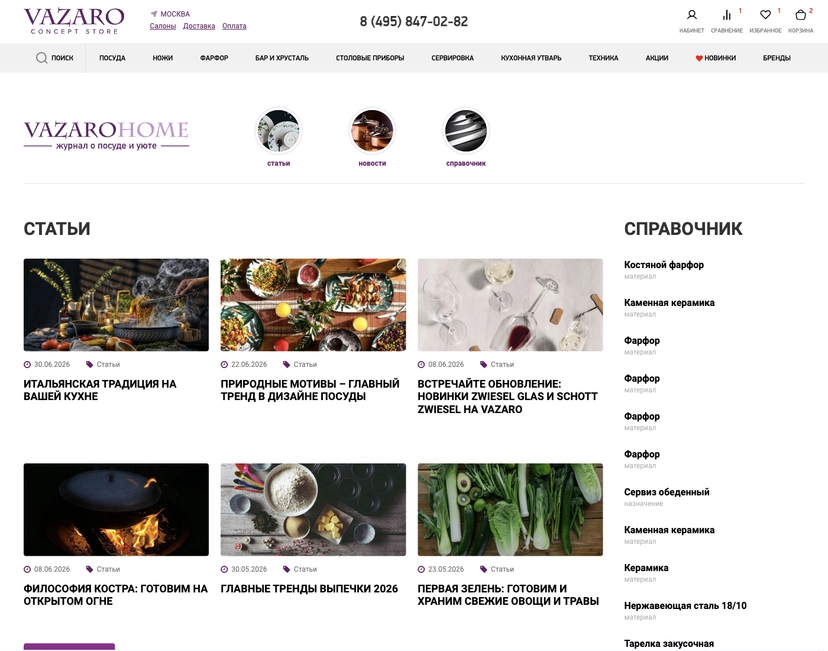
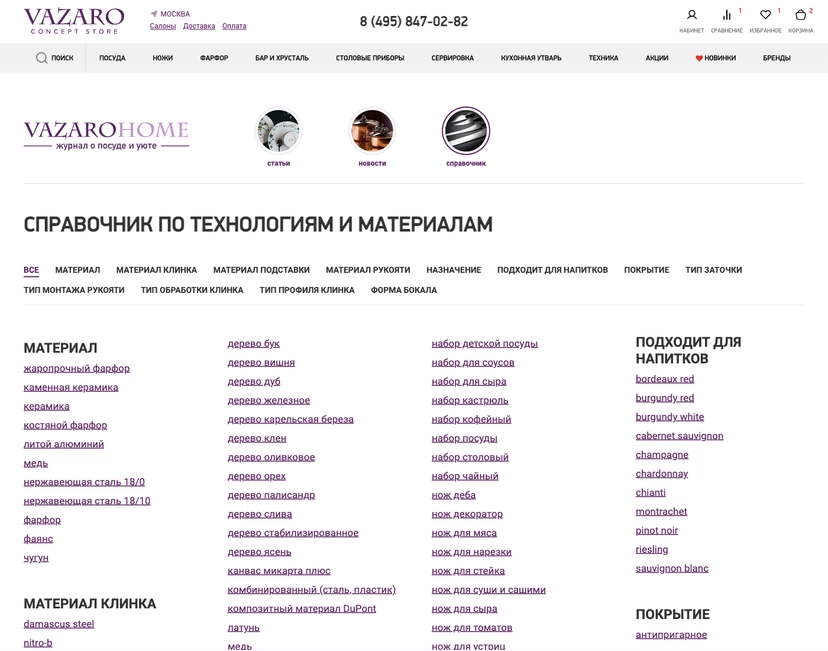
The old article section attracted attention but was weakly connected to purchase. We saw an opportunity to turn it into a useful part of the commerce system. The journal became not just a blog next to the store, but a structured layer of inspiration connected to products, brands, and collections. As a result, journal users added products to cart 5.6 times more often.
Performance
Users rarely describe a problem as "poor LCP". They simply feel that the store is inconvenient. For Vazaro, speed is not technical perfectionism. It is part of the normal shopping scenario. Fast page rendering, controlled media delivery, and two-level caching helped the website stay responsive as the catalogue and the number of integrations grew.
Fact: average server-side render time for catalogue pages is about 0.23 seconds.
Integrations
ERP and operations: 1C, Grotem, Bythand.
Payments: T-Bank, Platron.
Delivery and logistics: CDEK, Boxberry, PickPoint, EMS.
Analytics and marketing: Yandex Metrica, GTM, Calltouch, Yandex Direct, VK, myTarget.
Marketplaces and product channels: Yandex Market, Ozon, Wildberries, Price.ru.
Communications: SMS.ru, Sendsay.
Search, recommendations, and data: SOLR, GigaChat, RetailRocket, Dadata.
Results
Vazaro is not a series of separate projects for one client. It is a managed evolution of a platform that continues to accumulate business value.
-
18+years
of development without replacing the platform
-
5 000 → 58 000
SKUs
-
20→200
brands
-
150 → 3 970
catalogue branches
-
0 → 2 600
SEO clusters
-
20min
catalogue update time
-
+28%
growth in product findability after AI search launch
-
+72%
more add-to-cart actions among search users after the 2025 update
 Dmitry Peklenkov — CEO, Vazaro Retail